Before recorded history
Ancient Ardstraw tradition
The Raised Stone
Long before the family arrived, the valley of Ardstraw was steeped in sacred folklore. The prehistoric Ballyrenan Portal Tomb was known locally as The Cloghogle—“the raised stone.” Tradition held that ancient giants had hurled its massive stones across the mountains to mark their hunting grounds.
6th Century
Ardstraw tradition
The Trees Answer “Amen”
Saint Eoghan establishes the monastery at Ardstraw. Local folklore remembers his holiness as so complete that, while he prayed among the valley’s oak forests, the trees themselves answered him with a whispered “Amen.”
911
McNamee family history
The Northern Migration
Viking fleets push up the River Shannon and raid the Irish midlands. The Cineál Suibhne separate from their O’Mulconry cousins, leave their ancestral lands in Westmeath and move north into Ulster.
They form a lasting alliance with their northern cousins, the Cenél nEógain branch of the O’Neill dynasty, and receive a strategic border lordship centered on the ancient valley of Ardstraw in County Tyrone.
About 1010–1015
About these years · Family history
A Protector Is Born
An elite Cineál Suibhne chieftain is born into the Ardstraw frontier. His birth name has not survived. The name remembered across the centuries would be the warrior title he later earned: Cú Mhidhe.
1040s–1050s
Years of defense · Family history
The Rider Guards Ardstraw
Cú Mhidhe commands swift, bareback cavalry from a great wooden-palisaded rath overlooking the river bends. Decades of border campaigns make him a venerable warrior and patriarch—not a reckless fighter, but a protector whose strength is measured by the peace he keeps.
Under Brehon Law, his large household—and the 10 to 20 children tradition holds survived into adulthood—create a powerful kinship network. His title becomes inseparable from the people placed in his care.
About 1050
About this year · Family history
The Hound of Meath
Ardstraw stands as the defensive choke point where the O’Neill kingdom meets the hostile approaches from Meath. Through fierce, relentless and disciplined defense of that border, the cavalry commander earns the title Cú Mhidhe—The Hound of Meath.
In the Gaelic warrior tradition, cú meant more than hound. It identified a champion, guardian, warrior and protector—the trusted defender who stood between his people and danger.
About 1065–1075
About these years · Family history
The Hound’s Final Covenant
After surviving into his forties, fifties or perhaps sixties, Cú Mhidhe dies as a battle-tested patriarch. He is buried facing east in the sacred soil of Ardstraw Monastery.
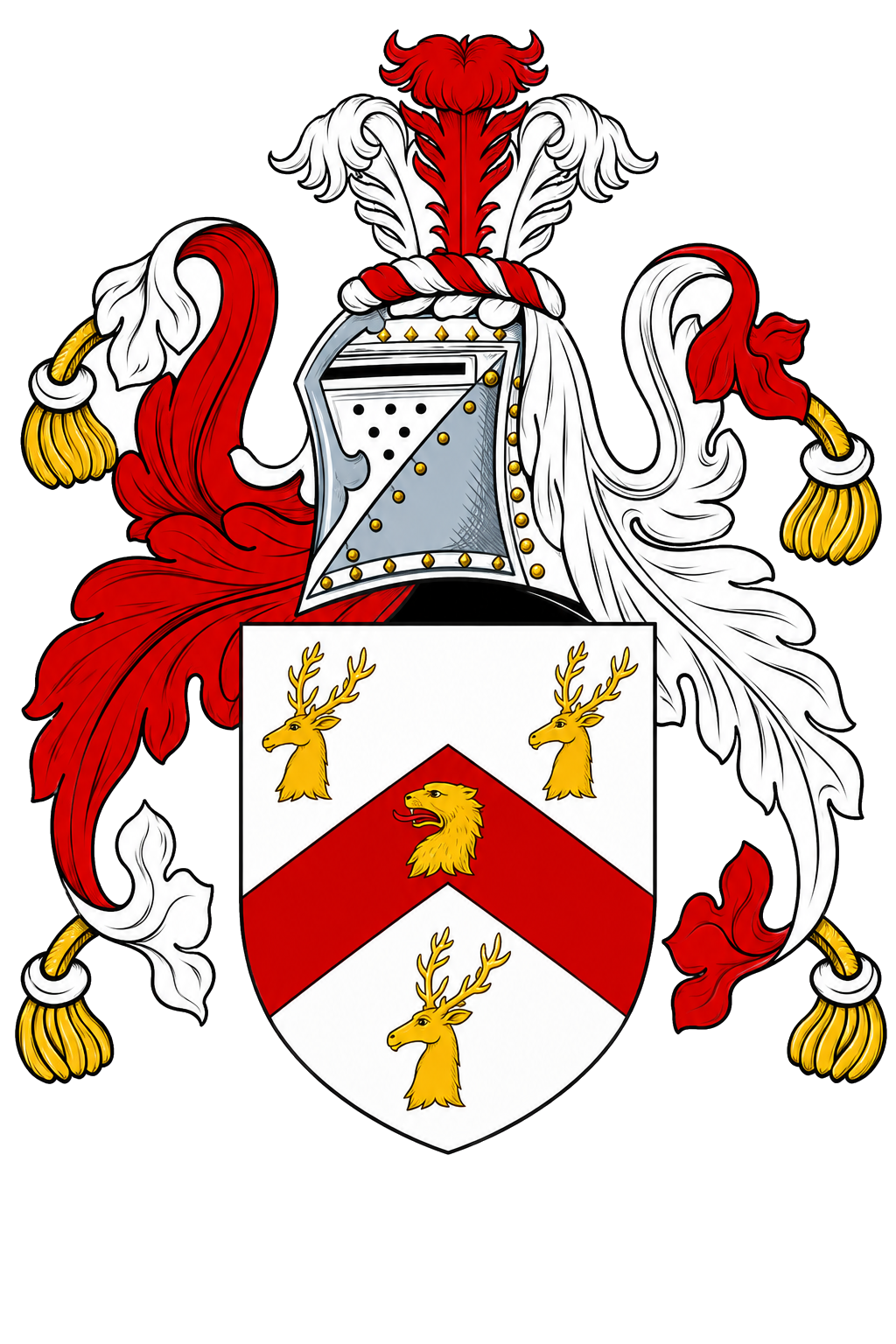
His sons and daughters honor his achievements by setting aside their older tribal name and calling themselves Mac Con Midhe—“Sons of the Hound of Meath.” His earned warrior title becomes their hereditary family surname.
About 1100
About this year · Legend
The Rider Is Seen Again
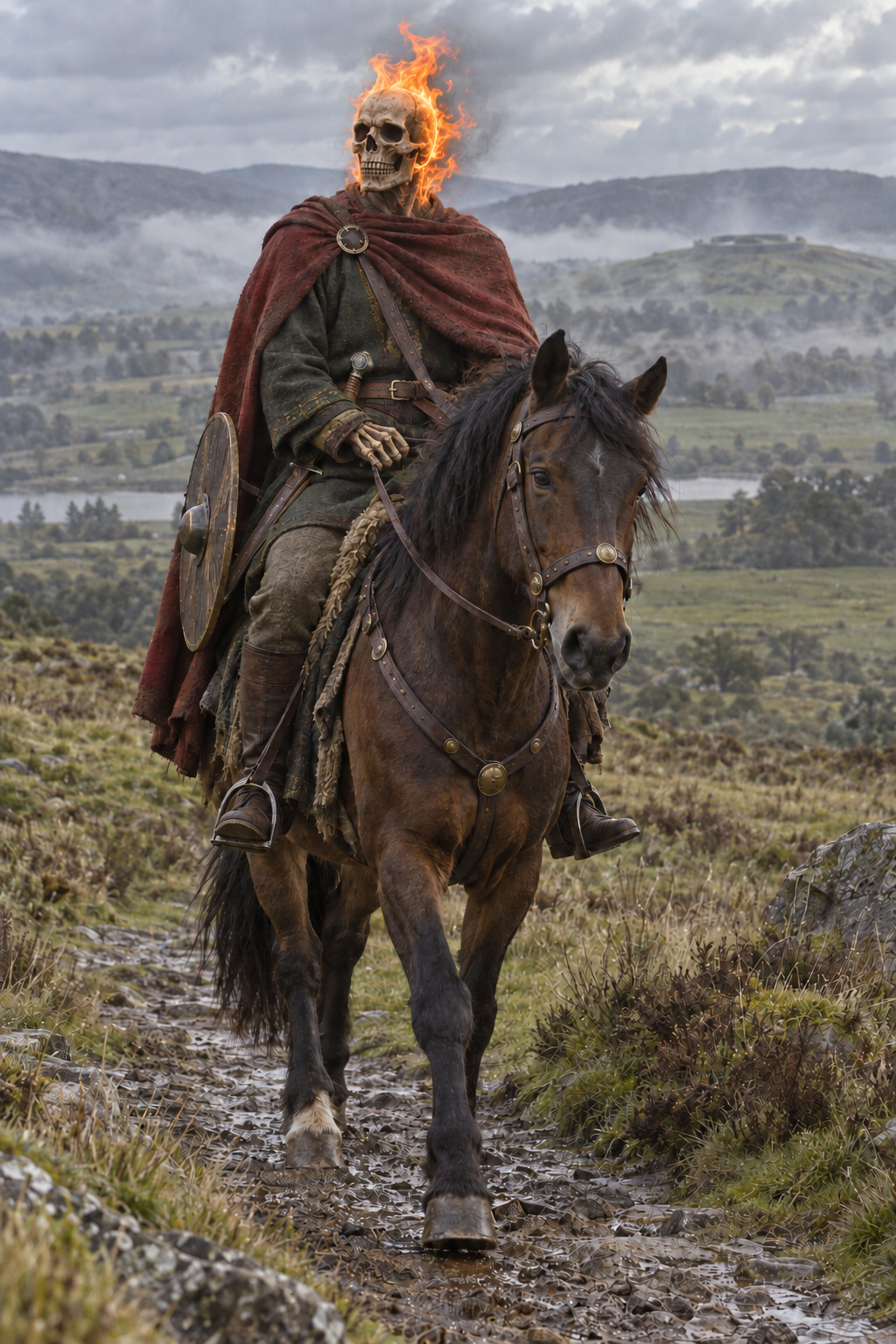
After Cú Mhidhe’s mortal life ends, travelers begin hearing hoofbeats on empty roads. Families in danger glimpse a solitary horseman watching from a distant ridge. When they look again, he is gone.
He does not appear to conquer or seek recognition. He is seen—or heard—when his kin need protection: silent, watchful and unmistakable. Some believe the Hound has returned. Others believe he never truly left.
1169
Historical anchor
The Sword Gives Way to the Quill
The Anglo-Norman invasion changes Irish warfare. Faced with the rise of heavy Norman armor, the Mac Con Midhe family makes a strategic transformation: they lay down the physical sword and raise the ink-dipped quill.
Their command of genealogy, law, borders and history carries them into the elite Bardic Order.
About 1200
Historical anchor
The Ardstraw Bardic School
The Mac Con Midhe estate at Ardstraw becomes a renowned bardic school and legal sanctuary. Under Brehon Law, an Ollamh—a master poet—held a rank comparable to a petty king and possessed diplomatic protection across hostile borders.
Students undertook a twelve-year course of exacting training. Tradition remembers them lying on stone beds in darkened rooms, memorizing hundreds of sagas, histories and genealogies while mastering the complex mathematical meters of formal Gaelic poetry. The family’s new weapon was flawless memory preserved in verse.
About 1210
Historical anchor
Giolla Brighde Mac Con Midhe Is Born
Giolla Brighde Mac Con Midhe becomes the legendary Chief Poet to the O’Neills. His mother’s Cenél Conaill blood connects him to the rival O’Donnell dynasty of County Donegal, giving him unusual diplomatic freedom to cross borders and compose for both great houses.
The family name preserves its meaning:
- Mac — son or descendant
- Con — grammatical form of Cú, meaning hound
- Midhe — Meath
1260
Historical anchor
A Lament for a Fallen King
High King Brian Ó Néill is killed and decapitated at the Battle of Down. Giolla Brighde mourns his close friend in the defiant political lament Aoidhe mo chroidhe ceann Briain, using poetry to protect the memory and honor of the fallen king.
1272
Historical anchor
The Quill Passes On
Giolla Brighde dies. Although his own children died young, his brothers and uncles preserve the Ardstraw school and pass its knowledge through the wider Mac Con Midhe family.
15th Century
Bardic dynasty
Conchobhar Ruadh and the Power of Satire
Conchobhar Ruadh Mac Con Midhe serves as Chief Poet to King Eoghan Ó Néill. He uses the immense legal and psychological force of justified poetic satire—áer—to arbitrate land disputes and hold powerful rulers accountable.
1595
Historical anchor
The Final Hereditary Ollamh
Brian Mac Con Midhe, the final hereditary Ollamh of the traditional line, dies. During the Tudor wars of Elizabeth I, his pen had served as a final shield, recording the lineages of Gaelic Ulster before the old order collapsed.
1606
Historical anchor
Guardians of Sacred Lands
Crown church surveys record branches of the Mac Con Midhe family serving as erenaghs—hereditary guardians and administrators of church lands—at Comber on the River Foyle. Even as the bardic world weakens, the family remains entrusted with sanctuary, history and sacred ground.
1607 and after
Historical anchor
The Dispersal
After the Flight of the Earls, the O’Neill lords leave for Europe and the Ulster Plantation seizes the lands around Ardstraw. Mac Con Midhe families scatter west into County Leitrim, County Donegal and parts of Connacht, while others remain in Tyrone and Derry.
As English replaces Irish in official records, Mac Con Midhe is written phonetically in new forms. McNamee becomes the principal spelling, while branches are recorded as Mee, Conmee and McConway; rarer English translations include Middleton and Milton.
About 1607
Ardstraw legend
The Sunken Bells
As raiding forces close upon Ardstraw, monks attempt to save their sacred bronze bells by casting them into the deep water where the Derg and Strule rivers meet to form the Mourne.
For centuries afterward, local people say the bells can still be heard on stormy nights—their muffled chimes rising through the swirling water.
1600s
Historic language anchor
Uisce Beatha
Ireland’s distilled spirit is widely known as uisce beatha—the water of life. English writers render the Irish words in forms such as uskebeaghe and usquebaugh. Over generations, the expression is shortened and reshaped into the word known around the world: whiskey.
The Rider recognizes familiar virtues in its making: grain, water, controlled fire, time and restraint—strength governed by patience and Spirit meant to be shared rather than wasted.
1824
Historical anchor
White Haven Is Established
A community rises along the Lehigh River—a mountain watchpoint that will one day stand within reach of the McNamee family’s scattered branches.
1841
Historical anchor
The Iron Horse
The railroad reaches the White Haven area, opening a path through Pennsylvania’s mountains that the Rider will one day follow.
Mid-1800s
McNamee family anchor
From Ardstraw Toward Belfast
Amid the economic aftermath of the Great Famine, Francis McNamee Sr. marries Mary McMullen, a daughter of the Ardstraw valley. They later move toward the expanding industrial port of Belfast in search of work.
1878
McNamee family anchor
Francis Joseph Is Born
Francis Joseph McNamee—later known as Frank—is born in Ireland to Francis Sr. and Mary McNamee. He is Janice McNamee’s grandfather.
1883
McNamee family anchor
Janice’s Family Line Comes to America
Francis Sr., Mary and five-year-old Francis Joseph leave through Belfast aboard an iron-hulled steamship. After an approximately eleven-day Atlantic crossing in steerage, they enter New York through Castle Garden—years before Ellis Island opened.
They continue west by Pennsylvania Railroad into the Pittsburgh region, later establishing roots near the Pitcairn rail yards and the communities that became Monroeville. This is the documented arrival of Janice’s branch, not the first McNamees in America.
The family legend says the Rider crosses with them, guarding the line through the ocean passage, the railroad journey and their first years in a new country.
Across the years
Family legend
The Long Ride
Other McNamee branches make homes in Ohio, Philadelphia and New York. The Rider travels between them and the Pittsburgh branch, bound by the oldest duty of the Hound: protect the family and preserve the line.
About 1915
About this year · Legend
The Rider Takes to the Sky
Cú Mhidhe takes the controls of a propeller airplane. His kin seldom see him arrive; they know only that he is there when needed.
About 1925
About this year · Legend
The Open Road
The truck and motorcycle join his mounts. New engines, same Rider: upright, watchful and unhurried.
2016
The homecoming
The Hound Comes to White Haven
When Janice McNamee and John purchase the White Haven property that will become Holy Ghost Distillery, the Rider comes with them. At first, his purpose is the same as ever: watch over Janice, her children and the McNamee line entrusted to his protection.
Then McNamees from Pittsburgh, Ohio, Philadelphia, New York and farther away begin gathering at the distillery. White Haven becomes the watchpoint from which roads reach every branch of the clan.
2019
His new home
The Rider Chooses to Stay
Cú Mhidhe remains in White Haven because the people he protects continue to gather there. The distillery becomes more than Janice’s home; it becomes a meeting place for the McNamee clan, their friends and those welcomed into their circle.
The Rider allows his image and Spirit to be placed upon shirts bearing his likeness or the McNamee name. The shirt becomes another mount, carrying him wherever its wearer travels.
Today
The mark and the Spirit
The Rider Travels with Us
The whiskey carries his story. The shirts carry his image. His story also lives in McNamee’s Black Irish Bourbon and Whiskey—the modern water of life.
Those who respectfully wear his name or raise his glass are welcomed beneath the Hound’s watch. They do not become McNamees by blood; they enter a fellowship bound by loyalty, respect and protection.
Wear his name, and the Rider travels with you. Raise his glass, and you are welcomed beneath his watch. He protects not only the person carrying his mark, but the people around them.
Respect everyone. Protect those beside you. Never cross the line—and never mistake restraint for weakness.